
Mine: Chapin Mine, Iron Mountain, MI


Many (see list) → Chapin Mine → Closed


Operated for 55 years.

From: 1879

Location: S 1/2-SW and SW-SE (Chapin); N 1/2-SW Sec. 30 T40N-R30W (Hamilton; N 1/2-SE and SE-SE Sec. 25 of T40N-R31W (Ludington). Ludington included the Bradley Mine (N 1/2-SE Sec. 25 to 1937)

Owned by: Originally owned by the Menominee Iron Mining Company, Milwaukee investors. Then sold to the Schlessinger mining syndicate; then temporarily by the Vanderbilts in 1891 and in 1892 repurchased by Schlesinger. Later sold to US Steel subsidiary M.A. Hanna Co. and later the Oliver Iron Mining Co.

Produced: Iron Ore, soft, non-Bessemer. Iron content 60-67%.

Method: Underground and later open pit. See notes.

Railroad connection: C&NW to Escanaba dock and MILW to their own Escanaba dock via E&LS. Later a pool arrangement.

Until: 1932, then from stock pile until 1934.

Lifetime Production: 27,506,868 tons from 1880-1934.
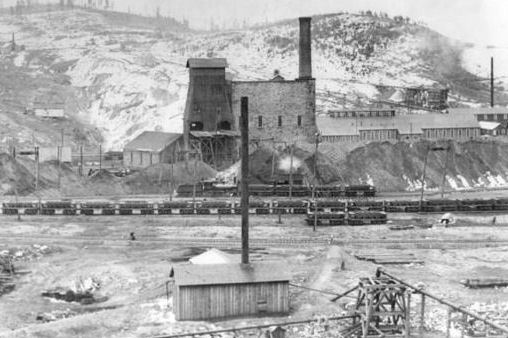

The Chapin opened in 1880 and shipped every year through 1934, except 1932 and 1933. The Ludington opened in 1880 and shipped through 1894. The Bradley shipped from 1937 to 1950. The Hamilton mine opened in 1886 and shipped through 1892. Shipments after 1892 included in the Chapin mine production.

Photo Info: Shaft D of the Chapin Mine in Iron Mountain, turn of the century. [MINARC]


Notes

For 45 years, the Chapin Mine in Iron Mountain was one of Michigan's most productive iron mines. The iron content of it's ore was high - 60-67% and the ore body was initially at about 400 feet. The mine later reached depths of about 1,500 feet. The downside of this mine was its high and substantial water level. Some of the largest pumps in history pumped water constantly from the mine to Lake Angeline and into the city's sewer system to keep the mine dry enough. A second downside of this mine was the silty sand, which some described as "quick sand", which created constant caves at the surface. This created constant problems for the two railroads, pipes and state highway (Stephenson Street) which crossed the cave area. The mine finally closed in 1932 and pumps turned off in 1934, ending an era of prosperity for the Iron Mountain area and its workers.

The property in later years was operated by the Oliver Iron Mining Co. Now abandoned and lease surrendered in 1934. Depth: 1,520 feet.

The adjoining Millie Mine (NE-NW and NW-NE Sec. 31 of T40N-R30W) was operated from 1912-1925 through the Chapin Mine workings but is now (in 1950) a North Range Mining Co. open pit operation. (See Millie Mine). [LSIO-1950]

Hamilton Shaft. The Hamilton Mine was discovered in 1883 and operated by the Hamilton Ore Co. until 1893 when it closed due to flooding. The mine was purchased in 1894 by the adjacent Chapin Mine, and linked by a series of new shafts, pumped out, and reopened. The mine had a boarding house, dry house and machine shop. [UPM] Editors Note: According to Sanborn Insurance maps, the Hamilton shaft was located west of US-2 on the north side of the cave-in. [SBM]

The Chapin Mine was a large iron ore mine in the middle of Iron Mountain, Michigan. It became a large open pit mine and ultimately a lake. US-141/US-2 traverses through the middle of the old Chapin Mine caving area. As the mine expanded, parts of the surrounding town and north/south rail lines were moved to accommodate mining.

Providence or Luck? A citizen of Berrien county. H.A. Chapin, failed in business but as honest man he turned all he had over to his creditors. Among his assets was forty acres of land in the western wilds of Menominee county (later set off to become Dickenson County). His creditors said: "We don't want that"; it is not worth looking after; you keep it". The man could not sell it at any price and kept it. On that tract is now the "Chapin mine' at the Iron Mountain. Mr. Chapin still owns the property and receives more than a hundred thousand dollars a year royalty from the mining company for the iron extracted. [LWR-1883-0912]

Image info: Below, a broad view of the Chapin Mine in 1911, looking north across the cave in. The railroad track going across the caved area is the CM&StP main line. At the time of this photo, the two adjacent tracks which are sunken are being used to raise the grade of the main line which is in the middle. It is a work in progress. Once the main line is raised, the two adjacent sidings will be raised as well. Then, the cycle begins again. Behind the rim of the cave-in are the vast stockpiles of ore awaiting shipment. A shaft house is to the left of the CM&StP and a trestle is used to spread the ore to the various stockpiles. The building at the far right next to the CM&StP line is likely a dryhouse for what was the Ludington mine. US-2/US-141 is off the photograph to the right. [UML]


Time Line

1879Ludington Shaft. The Ludington Mine was opened in 1879 and operated by the Ludington Co. until 1893 and was closed due to massive flooding. It was purchased in 1894 by the Chapin Mining Co. and linked to the nearby Chapin with a series of new shafts and pumped out. It was permanently closed in 1934. It had a Cornish Pump (still existing), pump house and dry house. Editors Note: According to Sanborn Insurance maps, the Ludington shaft was located west of the CM&StP main line on the south side of the cave-in area. The Hamilton shaft,, pictured in the image, was on the north side. [SBM]

1879. The Chapin mine is started east of the Ludington mine.

1880. The C&NW builds west from Powers to Antoine, passing the mine property. They also build the Chapin Mine spur, 0.7 miles long to the Bradley mine. This was the first mine through the new town of Iron Mountain. [MRL2]

1887. The Milwaukee & Northern railroad builds through Iron Mountain from Green Bay, and leases a right-of-way through the Chapin property. It becomes the Chicago, Milwaukee & St. Paul railroad (CM&StP) in 1893. A branch is built to the Chapin Mine in 1922. There may have been earlier connections and much of the mine trackage was used by both railroads. [MRL2]

1881. The Chapin mine has now opened by a series of shafts reaching to the 3rd level and connected by drifts along the southern wall of the vein or foot wall. The property is owned by H.A. Chapin of Niles, MI and Capt. T.B. Rundle is in charge of the mine. N.P. Hulst, Esq., is superintendent of the Menominee Mining Company which has secured the lease.

The deposit is from 50 to 80 feet in width and is a clear blue hematite ore of 60-67 percent of metallic iron and a bare trace of phosphorous. The amount raised daily is 600 to 800 tons. There are 8 shafts. No. 2 shaft is used only for lowering timber. The lower level is 210 feet below the surface. There is one Corliss steam engine in operation 16x42 inches and another, 18x42 is nearly ready. Together with a smaller one, 10x30 inches, which is to operate the electric lights with which the mine is soon to be illuminated. When the machinery now being put in is all in place and in operation there will be ten large five-foot drums in use hoisting ore. There are 19 hoisting drums of various sizes now in use at the mine and eight hoisting engines. 700 people are employed, about 350 of which are underground. [NWM-1881-0622]

1882. Ex. Governor Ludington and others have sold a thirty-second part of the Ludington mine for $50,000. The mine joins the celebrated Chapin mine of the Menominee Iron Mining Company. [GRL-1882-0927]

1882. October. A block of ground 150 feet wide, caved in at the Chapin mine, leaving a hole 50 feet deep. [HUR-1882-1005]

1882. The Chapin mine installs a compressor plant at Menominee Falls on the Menominee river about 2 1/2 miles from the mine. The plant provides compressed air which is piped to the mine and is used by pumps and machinery.

1883. May. The old dry house at the Chapin was entirely consumed (by fire) Sunday morning. There was a large amount of wire rope in the building which was much damaged. The loss was $2,000 with no insurance.[DFP-1883-0522]

1883. November. DISTURBANCES AT IRON MOUNTAIN, MICH. The strike at the Chapin mine at Iron Mountain assumed an alarming aspect Saturday. Four hundred malcontents approached Superintendent Stockbridge of the Ludington mine and requested an answer to their demands. He refused to yield. He was then thrown down, kicked and knocked around generally, during which cries of "kill him," "hang him," etc., were freely uttered. As soon as he recovered himself he told the men they could have anything they wanted, that they might all go back to work and consider their day's work done at any reasonable hour. The saloon keepers of Iron Mountain have all closed their places and consequently there is no drunkenness'. The local police force is powerless to do anything toward preserving order or quieting any disturbances that may arise, and it is altogether probable that one or more companies of the State militia will be ordered out to preserve peace and protect the property of the county. The Sheriff has been sent for and he will arrive tomorrow morning. [San Francisco Bulletin, November 19, 1883]

After being out for two hours, the pumps in the Chapin mine were started again by the master mechanic. The mine is under strong guard of Pinkerton policemen. The strikers are becoming desperate. Many residents of Iron Mountain, fearing trouble, are sending their families out of town until the difficulty is settled. Business is at a stand still. Some firms are fearful of losing thousands of dollars of account. [GRE-1883-1121]

1883. December. The water was let into the flume of the Hydraulic Power Co. this week at the Chapin mine. This improvement cost $200,000 and will be a saving of $60,000 a year and facilitate mining. pNwM-1883-1205]

1883. December 1. The trouble at the Chapin mine with the strikers has happily ended without bloodshed, save the death of one of the Pinkerton men who dropped his revolver which caused it to discharge, the ball entering his right breast, piercing the lungs and passing out under the left shoulder blade. He was 25 and unmarried. His remains were sent to Chicago. [NWM-1883-1205]

1884. February. One of the engine houses at the Chapin mine was destroyed by fire last week. Loss $20,000; insured for $10,000. [GRE-1884-0225]

1884. The mine is turning out 400 car loads of ore a day. [CCW-1884-0619] Editors note: During this time period, an ore car held 100 tons. This report would suggest that 10 trains of 40 cars were sent out each day.

1884. December. Another space of 100 x 100 feet at the great Chapin mine caved in yesterday, leaving a hole in the ground 50 feet deep with the mine office standing on the brink. No lives were lost but more ground is expected to fall in. [GRE-1884-1206]

1885. October, another extensive cave-in took place at the Chapin mine, undermining the railroad track and threatening a more serious disaster. The extent of the break is 80 x 150 feet, and the immediate effect will be to curtail shipments for the remainder of the season, as well as to hinder work below ground. [GRE-1885-1028]

1889. December. Four miners were killed on one day due to falling rock in the Chapin mine. One was taken out alive but died. The others were dead after the accidents. [DFP-1889-1214]. Editor's note; The Chapin mine was plagued with cave-ins and falling rock, likely due to the sandy conditions and water in the ground here.

1889. The Chapin mine is sold to Ferdinand Schlesinger of Milwaukee, described as the head of "a New York Jewish syndicate". The mine included a large air-compressor plant on the Menominee River (near Niagara, WI) which conducts compressed air for three miles through pipes to run the machinery. The ore vein is 3/4 of a mile in length, 140 feet wide and 1,200 feet deep. [DFP-1889-0208]

1891. Schlesinger builds the Escanaba, Iron Mountain & Western railroad from Iron Mountain and Antoine to Escanaba, with a spur to the Chapin Mine. The railroad builds a dock (#5) at Escanaba near the C&NW docks. This line becomes the "ore line" branch of the C&NW later that year when Schlesinger get in financial trouble. [MRL2]

1891. January 8. The Chapin mine has been sold by Ferdinand Schlesinger to Andrew Carnegie of Pittsburg, M.A. Hanna of Cleveland and J.A. Van Dyke of Milwaukee. The new management takes control at once. The Marquette dispatch says the Schlesinger syndicate is in financial straits and their men have not been paid for two months. Schlesinger has resigned from the presidency of all the various companies with which he is connected. He says the embarrassment is merely temporary, caused by the stringency of the money market. [SAG-1891-0108]

1891. January. Negotiations are now pending for the purchase of a series of mines by the Vanderbilt family. This includes the Chapin mine as well as the  Florence, Iron River, Youngstown and the East Negaunee group. All are now owned by the Schlesinger syndicate. The valuation is $5,000,000. [LSJ-1891-0127] Editor's note: At the time, the Vanderbilts had controlling interest in the Chicago & North Western, a major transporter of iron ore in the U.P. Schlesinger had built and just opened the competing EIM&W ore line. Schlesinger had also purchased a right-of-way northwest towards his mines at Crystal Falls and Iron River, again threatening C&NW business. Within one year of opening, the EIM&W became part of Vanderbilt's C&NW.

1891. January 30. The Chapin mine caught fire at the sixth level and eight miners were reported to have died in the fire. [NDS-1891-0130] Later reports indicate six escaped the fire but two died. The mine is sealed off and it will be weeks before mining can resume. [LSJ-1891-0131] As crowds hurried to the scene smoke was seen issuing in great black clouds from "C" shaft. The fire companies were speedily pouring water down the shaft but their efforts were wasted. The smoke increased and soon began to issue from "B" shaft, the large timber shaft near the saw mill and from other openings. It was decided to close down all the shafts except "C" and await developments.

The fire occurred during the supper hour when few men were in the mine. There is also a tool box, waste, oil and other combustible material in it, and it is supposed that this is where the fire is. If so, it is thought that the fire cannot spread to other parts of the mine because the mine is a wet one and timbers elsewhere are constantly saturated with water. The fire will not be as bad as the one at the Calumet & Hecla mine because the Chapin is not so deep, is much wetter and the fire is located where it will finally go out by itself for lack of material to feed upon. The mine will likely be opened within a week or two at the farthest. A third miner has died from his injuries on February 7. [IWT-1891-0207]

1891. February 14. But for the Iron Mountain water works, Iron Mountain's largest mine would have experienced an industrial loss that would have set her people back at least a year in material progress. Mine authorities say that but for the water works, their "C" shaft would have been entirely destroyed and that destruction of this shaft would have been great. When the city council granted W.R. Coats a franchise to construct and maintain the (water works) system, some at the time thought we had done a foolish thing. We believe that our city is far better off in paying $9,000 per year for hydrant rental that she would have been had she issued $150,000 in bonds and built these works herself.  [KGAZ-1891-0214]

1891. Noted to be the second highest producing Bessemer iron ore mine in Michigan. At this time it is owned by the Schlesinger syndicate with ore being sent to the Escanaba docks via the Schlesinger railroad ore route (which later became the C&NW ore subdivision).  Reported to be shipping five daily trains of fifty cars each. [DFP-1891-0202]

1891. February 11. Mining has restarted on the Chapin mine. [GRE-1891-0211]

1891. March 3. Mr. Schlessinger said the Escanaba & Iron Mountain railway has been sold to a syndicate of capitalists. Along with the railroad went ½ of the Chapin mine and half-interest in six steel steamers being built at Cleveland. The Florence mine has been disposed to other persons than those who took the railroad. [JCP-1891-0303]

"I still control the four mines at East Negaunee and the York-Clare and Armenia mines at Crystal Falls and will manage them", Schlessinger said. "It is probable that the Negaunee mines, the Buffalo, South Buffalo, Queen and Prince of Wales will be consolidated". The four Negaunee mines which are to be consolidated adjoin each other and their consolidation was contemplated when Schlessinger first bought the mines. It is speculated that the syndicate purchasing the railroad and Chapin mine included Hamilton McK..?.; Frederick W. Vanderbilt, and M.A. Hanna. [IINR-1891-0307]

1891. March 16. An Italian named Antonio Alonzo, while carrying a pail of water in the "B" trestle engine house at the Chapin mine accidently fell on the fly wheel. His head was completely cut off. [SAG-1891-0316]

1892. June 1. For a consideration of $3,000,000 Ferdinand and William Schlessinger of Milwaukee have concluded the purchase from William Vanderbilt of New York and M.A. Hanna of Cleveland of the Chapin iron mine, near Iron Mountain and the Menominee Transit Line, which included six steamers engaged in the ore trade between Escanaba and Lake Erie ports. The Schlessinger's were forced to sell off the Chapin mine and other properties to Vanderbilt and Hanna last year because of a stringency of the money market, and now are obliged to pay a big bonus to get them back. [GRE-1892-0601] Editors note: The repurchase did not include the EIM&W railroad which was now under C&NW control.

1892. September. The Chapin mine employs 1,100 men who take about 125,000 tons of ore out monthly. This equals about 1,250 100-ton railroad cars per month. [IND-1892-0917]

1893. January. One of the largest pumping plants in the United States, built by the Edward P. Allis company of Milwaukee, was placed in operation at the Chapin mine Friday. This plant is capable of raising four million gallons of water in 24-hours and will be used to handle all the water from the Chapin shafts. [DFP-1893-0108] The length of the bob to the back of the fly wheel is 75 feet and the height of the plant above the foundation is 54 feet. The high pressure cylinder is 50 inches in diameter, the low pressure cylinder 100 inches. The bob weighs 120 tons, the fly wheel 160 tons. The total cost of the plant was $325,000. Editors note: A "bob" refers to a specific type of counterweight assembly used to balance the crankshaft and flywheel components. [GGAI]

The pump was shipped to the Chapin last summer, with the expectation that they would have to use it to clear the mine of water that was expected to break in at any time. Up to a short time ago the pump was not needed. The mine just above Mr. Chapin's has been flooded for some time (the Ludington and/or Hamilton) and it was expected that water would break in at any time. With these conditions the pump was ordered by the company. The pump was so large that it took 40 railroad flat cars on which to ship it. [NDS-1893-0109]

1893. April. The Chapin mine has just received a large-sized Marston steam shovel for loading ore from stockpiles. The former shovel of another make has been sold to the Aragon Iron Co. of Norway. Chapin's "D" shaft has just been completed to the back of the 9th level. [IWT-1893-0429]

1893. June 24. A cave-in at the Chapin mine last Monday buried two Swedes named Larsen. A force of men are trying to recover the bodies. [LAS-1893-0624] It was thought that they had been buried alive. The two were found standing upright, dead. Their mouths, noses and ears were filled with (quick) sand. They are supposed to have died within a few minutes after the cave in occurred as all air was shut off. [LSJ-1893-0630]

1893. July 29. The late smash of the Schlesinger's seems to have been more fatal than was expected. It is known that the Vanderbilts' and M.A. Hanna & Co. have (again) acquired a controlling interest in the big Chapin mine and as the former have had no use for the Schlesinger's since they built an opposition railroad line from Iron Mountain to Escanaba (the EIM&W). It is safe to say that now that they have those energetic Germans in their power they will tighten up the thumb screws to the last notch. [IWT-1893-0729]. Editors Note: The Vanderbilts had controlling interest in the C&NW at this time and took over the EIM&W, owning both lines.

1893. August 11. The reorganization of the Chapin mine was completed at a meeting held in the office of Ferdinand Schlesinger. In the reorganization, Schlesinger retires and the company issues $1,038,000 in bonds to meet debts to the laborers, freight, royalties and the future operation of the mine. The liabilities of the company for freights, supplies, royalties, etc. are $625,000; the assets are $600,000. R.C. Flanagan of Norway, MI was elected trustee. [SAG-1893-0811]

1893. August 12. The Chapin mine closed down yesterday, throwing 800 men out of employment. The outlook for upper peninsula mining towns for the coming fall and winter is very dark. All the best mining properties are in the hands of a syndicate of speculators, who make more money by failing than by carrying on a legitimate mining business. [JCP-1893-0812].

1893. September. Shipping operations were resumed at the Chapin and the stock pile of 102,000 tons of ore will be sent to Escanaba and Gladstone docks as rapidly as possible. 40-50 men will be employed and it is expected to move 2,500 tons daily. [LAS-1893-0923]

1893. December. Dickenson County prosecuting attorney appealed to the Menominee common council to assist destitute families of Iron Mountain who must have assistance at once. These families represent nearly 1,000 people. The city of Iron Mountain has managed to take care of them since the closing of the Chapin mine last July, but is now forced to call for outside aid. $500 was appropriated by Menominee for the destitute miners of the upper peninsula, regardless of locality, and it is now proposed to send that amount in provisions to Iron Mountain. [DFP-1893-1203]

1894. May. The Chapin mine will resume operations with 500 men, which force will be added to as rapidly as possible. The opening owes to the liberality of M.A. Hanna & Company who furnished funds to operate the mine. Mr. Chapin of Niles, MI, owner of the fee, waived all rights to royalty for a year. Mr. Chapin also contributed several thousand dollars for the sufferers here. [LSJ-1894-0503]

1894. October 29. The 30 year lease of the Chapin mine, together with all buildings, machinery and 2,000 shares of stock in the Hydraulic Power Co. were sold today by Court Commissioner Hammond to M.A. Hanna & Co. of Cleveland, for $88,973.46. Only a few years ago the property was sold by the Vandykes of Milwaukee to Fred Schlesinger for $2 million. The indebtedness represented by Trustee Flannagan aggregates was $648,780. [JCP-1894-1029]

1895. The Chapin mine will commence sending ore to the Escanaba docks and the season's shipment will exceed 200,000 tons in stock pile. The C&NW will handle the business. Last season, the St. Paul handled half their product. [SCH-1895-0418] The St. Paul company has removed their side track leading to the mine. [IWT-1895-0427]

1895. November 20. The Chapin mine secures control of the Ludington and Hamilton mines, two of the largest producers of standard ores in the Lake Superior district. These two mines were flooded four years ago by something bursting, and have since been idle. [DFP-1895-1121]

1896. June 15. IRON MOUNTAIN, June 15---An attempt was made Sunday night to kill Captain Martin Goldsworthy and family of the Chapin mine. Two sticks of dynamite were exploded under their house, wrecking the structure badly. Nobody was injured. There have been no troubles at the Chapin mine and the men are apparently contented. It is thought the act was committed by men whom Captain Goldsworthy had refused to employ. [KGAZ=1896-0619]

1896. The St. Paul company have removed their side-tracks leading to the Chapin mine. The North-Western will handle the entire output this season, which will increase the shipments from Escanaba very materially. [DD-1896-0415]

1896. August. Wednesday, just before six o'clock, a train of ten loaded ore cars was being let down from the C shaft of the Chapin mine, and at the same time a train of empties was being pushed up from the main track. It was during the hardest part of the rain, which probably accounts for the train men not seeing each other to prevent the collision. The trains met just back of the Chapin mine office, and a bad smashup occurred. One of the locomotives was rolled down the embankment and lay bottom up, while several cars were smashed up and scattered about on both sides of the track. The other locomotive was also considerably damaged. Fortunately the train men jumped in time to save themselves and no one was hurt. The wrecking train was put to work early next morning gathering up the pieces, and the track is now clear. [RTR-1896-0805]

1896. September 25. A fire was discovered in shaft "A" of the Chapin mine. The heavy timbers were ablaze and it appeared the fire would reach the main shaft. The fire department was able to get the blaze under control. Only damage was to machinery which is insured. [SAG-1896-0925]

1896. October 20. The Chapin company is opening the Hamilton mine, idle since 1882, and is running several drifts connecting the two properties. Between the two some very large and rich ore bodies have been found. The Hamilton has just been un-watered by a new plan. In two months 122,500,000 gallons of water were taken out at the rate of 1,356 gallons a minute, including all the time from beginning to end of operations. [NDS-1896-1020]

1898. December 17. Henry A. Chapin, millionaire mine owner and one of the richest men in Michigan, died last night at his home in Niles, MI. He was fee owner of the Chapin mine property. He was 86 years old and leaves a wife and one son, C.A. Chapin, of Chicago. He is estimated to be worth $10 to $30 million. Death was caused by old age. [SAG-1898-1217]

1899. July 28. A big transaction involving the transfer of property worth several millions of dollars from M.A. Hanna & Co. to the National Steel Company was consummated yesterday. The sale includes the Chapin mine at Iron Mountain and the Winthrop Iron Co. mine of 100 acres in Ishpeming. It also includes four steamers of the Mutual Transportation Co. and five steamers from the Menominee Transportation Company,. This transaction, one of the largest in recent years, means that M.A. Hanna & Co. is to retire from the mining and transportation business. [AADT-1899-0728]

1901. The vast body of water in the Hamilton shaft of the Chapin mine struck at a depth of 1,800 feet which has been troublesome for over a year, is now thought to be a part of the Menominee river from the fact that below the falls of this river at Niagara, WI, four miles from Iron Mountain, the volume of water is more than twice as great as at the upper river, with no known tributaries or feeder of any kind except the subterranean streams of the mine. The water is as clear as crystal and has the tremendous pressure of 235 pounds to the inch. Editors note: In other words, the water pumped from the mine contributes ½ of the total water of the Menominee River below Menominee Falls as it flows to Lake Michigan via Menominee and Marinette, WI.

Beautiful snow white sand brought to the surface by the big pumps indicates that the shores of this underground river are lined with an abundance of the finest building sand in the world In the vicinity of the supposed river the ground is gradually settling at the rate of two inches a day. A large force of men is constantly employed by the CM&StP and Northwestern railroads in filling the cave and keeping their track from sinking out of sight into the cave-in. The water is one of the wonders of the mining world and every day the interest increases. Thousands of dollars have already been expended in trying to successfully solve the problem of keeping the mine dry. [LAS-1901-0302]

1901. June 4. At the Chapin Mine, in Iron Mountain a dynamite explosion caused 8 fatalities. 30 children were rendered fatherless by the explosion. [JCP-1901-0604]

1901. June. The hydraulic works, two miles from Iron Mountain on the Menominee River, owned by the Chapin Mining Co. was totally destroyed by fire early this morning. The buildings and all machinery were totally destroyed. The hydraulic works furnished all the power for the Chapin mine and cost half a million dollars. It will take many months to rebuild. It is thought the mine will close down, as it has not sufficient steam facilities to take the place of the air provided by the works. One employee was badly burned while trying to escape. [DFP-1901-0626]

1902. January 4. The Chapin mine has been transferred to the Oliver Mining Co. which is a Steel Corporation property. The Quinnesec mine has also been transferred to Oliver. [DFP-1902-0105]

1902. July 12, Somebody this morning about 2 o'clock put a big stick of dynamite under the large pipes conveying compressed air to the Chapin mine and exploded it. The pipes were ruined and the mine put out of business for the time being. This compressed air operated the pumps and drills at the mine. There is no clue to the perpetrators. [KGAZ-1902-0713].

1907. May. An ore train nearly collapsed into the Chapin pit at Iron Mountain. The slide of the pit occurred at 4:20 am and the tracks dropped 8-10 feet. The engine derailed but did not end up in the pit. The cars stayed on the track. Following instructions the engineer reduced speed as the divide was being approached. While creeping along he noticed the engine sinking. He applied his brakes just in time to save the string of 46 empty cars from a general smashup. It was necessary to transfer the passengers on the eastbound trains from Antoine to the (Iron Mountain) depot and vice versa taking them around the loop line. Depending on the direction in which they were headed, the cross over being made near Norway. [DD-1907-0518]

1911. SNAPSHOT. The Chapin Mine is located in Iron Mountain, Michigan, and is a property of the Oliver Iron Mining Company and has been in operation since 1879. The Chapin has three shafts, the “B” Chapin, No. 2 Hamilton, and “C” Ludington. “B” Chapin is at this time idle on account of alterations being made to its hoisting plant. No. 2 Hamilton, since the sinking of “C” Ludington was completed, has been used for hoisting and lowering men and timber only. Pumps are also located on the 12th and 16th levels of this shaft, which, until the Cornish pumping plant was placed in operation, were used for pumping all the coming water in the Chapin Mine.

Since the date of the last meeting of the (Mining) Institute on the Menominee Range (in 1905), a few changes have taken place in the way of equipment at the Chapin, which might here be briefly described. The sinking of “C” Ludington shaft has been completed. At this shaft the entire product of the mine is hoisted, and here, also, the greater portion of the pumping from this property is carried on at the “C” Ludington shaft which is 10’ 4” by 21’ 3”; is steel lined and has a depth of 1,522 feet, or is down to what is known as the 17th level. The shaft has two skip compartments, each 5’x6’; one cage, 5’x10’ 4”, and one compartment 9’ 3”x10’ 4”, used for ladderway, pump columns, air lines, electric wires, etc. Two five ton skips are operated in this shaft; the product of the mine being hoisted from what is termed the 14th, or main working level, and which is located 1,201 feet from the surface.

The equipment at “C” Ludington shaft consists of one 34 x 72 inch single duplex first motion Corliss hoisting engine, operating a single drum, 12’ diameter, 10’ face, grooved for 1⅜” rope and is used as a skip hoist, and one 30 x 60 inch simple reversible Corliss hoisting engine, geared to one 12’ drum, 10’ face, grooved for 1⅜” rope, and used as cage hoist. Electric generator plant for operating underground electric haulage consists of one 100 kilowatt direct current, 250 volt, 400 ampere belt driven generator, driven by 14”x36” Corliss engine, and one two unit, three bearing induction motor generator set, 200 K. W. 250 volt, 800 ampere. The boiler plant consists of four 72”x15’ horizontal tubular boilers. As all the machinery described above is operated with compressed air, this plant is used only in case of emergency.

At this shaft there has also been installed, and is now in operation, a Cornish pumping plant, which, some 15 years ago, was located in “D” shaft Chapin Mine. This plant may be described as a Steeple Compound engine with high pressure cylinders 50 inches diameter, low pressure 100 inches diameter, stroke 120 inches and fly wheel 40 feet in diameter, weighing 160 tons. The pump is of eight-lifts construction, six sets each 192 feet apart and two sets each 170 feet apart. Plungers and discharge column 28 inches diameter, pump rods 7” and 8” diameter. Capacity of pumping plant 3,000 gallons per minute from depth of 1,500 feet. For operation of the pumping plant, there have been installed six 72”x18’ horizontal tubular boilers. The building containing these boilers is one of the standard type of the Oliver Iron Mining Company. [LSMII-1911]

1911. SHAPSHOT of the COMPRESSOR PLANT. Mention might also here be made of the Chapin Mine air compressor plant, located at what is known as the Upper Quinnesec Falls on the Menominee River, about three miles southeast of the mine. This plant was installed in the year 1882. During the years 1903 and 1904, and subsequent to this time, some changes were made in the plant, one of which consisted of building a steel flume to replace the wooden flume originally built. This new flume has a length of 382 feet, is 16 feet deep and 22 feet wide and is supported by 72 concrete piers. New air cylinders of the Corliss valve type, have also been installed, three pair being 34 x 60 inch and one pair 38 x 60 inch in size, replacing three pair 34 x 60 inch and one pair 36 x 60 inch of the old poppet valve type. Each pair of the cylinders are driven by 50 inch special double horizontal turbines. A pipe line 24 inch in diameter, conveys the compressed air to the mine a distance of 16,665 feet, a distance of 3.2 miles. This pipe is built in lengths of 58 feet each, the material being riveted wrought plates ¼ inch thickness. At the present time, all machinery at the Chapin Mine, with the exception of the Cornish pumping plant, is operated by compressed air. [LSMII-1911] Editors note: This 24 inch air pipe, along with a water discharge pipe crossed the mine cave-in area next to Stephenson highway. It had to be regularly supported with fill to keep it intact.

1921. June. Work at the Chapin mine and at the Aragon at Norway will cease today for an indefinite period. The decision of the Oliver Mining company was announced this week due to discouraging conditions in the iron and steel trade. [IDG-1921-0523]

1922. January. Water at the Quinnesec Falls plant of the Oliver Iron Mining company is the lowest it has been in 40 years, according to the chief engineer. The electrical equipment is operating at less than ½ capacity. Both generators are in constant operation but instead of developing their rated 1,875 kilowatts each, are producing about 800 kilowatts and the steam generator at Norway was started yesterday to help carry the light load developed with the mines idle, excepting for pumps and lighting. The air compressors supplying the Chapin mine here are operating satisfactorily although the load is a very light one now. [IDG-1922-0131]

1922. February 13. Trestle work has started at the Chapin mine and the Aragon mine in Norway, properties of the Oliver Iron Mining company, following the announcement that the mines would resume operations after an idleness of about eight months. The closing of the two mines threw about 1,000 men out of work and for several months the men have virtually laid siege to the Ford Motor company office (in Kingsford) in quest of work. A number of them have said they will work at the factory and give up mining. [DFP-1922-0213]

1922. November. Arrest made. After working a year on the mysterious blasting of the Chapin mine air line here on May 10, 1921, John Midhela, head of the Oliver Iron Mining company police, Sheriff Farrell and Prosecuting Attorney Knight have arrested Louis Turbessi, 38, employee at the mine in connection with the crime. A married woman who claims Turbessi is the father of her baby, is largely responsible for his arrest, for she admitted he told her he dynamited the air line. He recently returned from Italy and brought his wife and two children with him. During the depression that year the Chapin mine laid off all single men and he was included because his family was in the old country. He became angry and was loud in his protest at being discharged. Officers say he visited another man's wife. A note found tied to a power line read: "Everybody's got the right to live and eat, so this is just a warning, and if it doesn't change it will be still worse." [KGAZ-1922-1120]

1923. February. The sum of $25,211 was paid in pensions last year by the Oliver Iron Mining company a subsidiary of U.S. Steel trust. Of this, $16,256 was paid to former employees of the Chapin mine, $8,981 to the Aragon at Norway, and $974 to the Riverton at Iron River. [DFP-1923-0219]

1925. September. Not withstanding the drought that has curtailed the water supply in some parts of the upper peninsula, Lake Antoine near Iron Mountain has an almost inexhaustible source from the Chapin mine, which is capable of being pumped into the lake at a rate of 19 million gallons a year. The regular flow of water from the mine is about 3,600 gallons per minute, of which 2,000 gallons per minute will be diverted into the recently completed 16 inch reservoir near the Hamilton shaft to Lake Antoine, totaling about 3 million gallons daily. The lake is now six feet below normal. Iron Mountain is using about 2,250,000 gallons daily. The Oliver Iron Mining company has placed an electrically driven centrifugal pump, through which the water will be pumped, making the city a gift not only of the water, but the cost of operating the pump. The city built the 16 inch main. [MUSC-1925-0925]

1927. The Oliver Iron Mining Co. employs 600 men at the Chapin mine in Iron Mountain. The mine has been shipping stock pile. The Ludington is now the production shaft for the entire Chapin Mine. [MCH-1927-0902]

1932. July 23, Operations at the Chapin mine will be suspended August 1 by the Oliver Iron Mining Company, a subsidiary of US Steel corporation it was stated today by George C. Eisle, superintendent for the Oliver company on the Menominee and Marquette ranges.

About 450 men are affected by the shutdown. The pumps however will not be pulled until December 31 to give the fee owners opportunity to inspect and survey the property, with the possibility that some other company may take over its operation. It is reported that there is a known ore reserve in the Chapin of 800,000 tons, with such other possible reserves as have not been revealed by exploration.

Closing down of the Chapin has been hastened by several years because of the depression. In all of its immense holdings the Oliver company is operating only three mines - the Chapin, the Riverton at Iron River and the Pioneer in Ely, MN. Conditions reached a point where it was believed advisable to suspend operations at the Chapin.

It was just about a year ago that the Oliver also gave up its lease on the Aragon mine in Norway and pulled the pumps.

The Chapin mine has been one of the largest underground producers in the history of the industry. It is owned by the Chapin estate and was first opened in 1879. Since that year its annual production has run as high as a million tons and its list of employees topped the 2,000 mark. In all, the total production has been 27 million tons, although in recent years the output has been reduced to less than ½ million tons annually and payroll likewise cut.

Employees of the company were being notified today of the shutdown. Practically all of them will be given outright leases (on homes). The general office will remain open until December 31.

If eventually the pumps are pulled it will leave the city of Iron Mountain facing a new problem that of finding a source of water supply. The mine pumps about 3 million gallons of water daily, part of this being piped to Lake Antoine to replenish the city supply, and the remainder being emptied into sewer creek. If the pumps are pulled the city's only alternative will be to go to the river.

Closing down the property will also take a large slice off the city's assessment roll. [WAK-1932-0723]

1933, February. The fee owners of the Chapin property are the Keweenaw Land Association, the Charles A. Chapin estate, and the Hamilton-Merryman Company. [BH-1933-0224]

1934. April 9. Operation of the pumps at the Chapin mine were stopped shortly after four o'clock yesterday afternoon upon orders received from LeRoy Salsich of Duluth, president of the Oliver Iron Mining company. The news, conveyed to city officials about 5 o'clock, left them flabbergasted. For weeks they had been working upon a proposition to purchase the Oliver's Quinnesec falls hydroelectric plant and arrange for another operator of the mine. Recent negotiations had taken a promising turn and they were visibly disturbed by the sudden reversal in events. [EDP-1934-0410]

1934. May 20. The first shipment of iron ore from the 120,000 ton stock pile of the Chapin mine was loaded in the city May 14. The shipment consisted of 36 carloads and it is going to the steel mills via the Escanaba docks. All of the ore will be consigned to the US Steel Corporation. [EDP-1934-0520]

1934. July 20. Oliver Iron Mining Co. has sold to the Wisconsin-Michigan Power Co. (a subsidiary of the North American Co.) the Big Quinnesec Falls hydro-electric plant on the Michigan side of the Menominee river. This transaction is a sequel to the surrender of the lease by the Oliver to the famous Chapin iron mine at Iron Mountain. The mine was operated by power from this plant. Instead of operating their mine, the power in future will be distributed over central and southern Wisconsin for general commercial power purposes. The consideration is not mentioned, though it is known that the City of Iron Mountain which contemplated buying the plant could have purchased it for $500,000. Officials of Iron Mountain sought to induce other mining interests to take over the Chapin on the theory that the property could still be operated for some years with possible profit. [BH-1934-0720]

1934. October. Work of dismantling the compressed air line consisting of 2,500 feet of 24 inch steel pipe that connected the Chapin mine with the Big Quinnesec falls on the Menominee river is underway.

1934. November. Tourists and visitors to Dickinson county next season will see the unusual attraction in the famous old Cornish mine pump at the Chapin mine. The pump is 44 years old and of enormous size. The part above ground cost $85,000 and total investment was around $250,000. The engine is 54 feet and the flywheel is 40 feet in diameter and weighs 160 tons. It is proposed to raze the building on Ludington hill, dress the pump in aluminum color and let it stand like a sentinel on the hill. The Oliver Mining company has offered the pump to the county. The ground on which it stands is owned by the Keweenaw Land Association and the later will lease the location to the county at a nominal sum. [EDP-1934-1125]

1935. March. Answering persistent questions as to just what might happen if the water in the Ludington shaft of the abandoned Chapin mine - now about 200 feet from the surface - should rise to the top and overflow. H.L. Senseman, city engineer, believes that in all probability nothing will happen, for the water may never reach that point.

If it should, the engineer added, it would likely do nothing more spectacular than to flow off into the Chapin pit and eventually find an outlet into sewer creek and thence to the Menominee river. [EDP-1935-0320]

1935. July 24. Carloads of gravel were being dumped today along the road bed of the CMStP&P railroad near the north end of the main line over the Chapin pit, which gave way Saturday sending tons of the road bed sliding down the steep embankment to the bottom of the pit. Dirt will be hauled at the rate of about 4,000 yards a day, and it is estimated that two or three days will be required to fill in the embankment. [EDP-1935-0724] Editors note: In 1937, this main line of the Milwaukee Road was diverted east along side the C&NW and Stephenson highway.

1937. July. Pumping of water into Crystal Lake (southwest of downtown Iron Mountain) or at least the mud flat that used to be Crystal Lake, was started by the city water department. A half million gallons, the full capacity of the line, will be emptied into the lake daily, being pumped from the Hamilton shaft of the former Chapin mine. Pumping is maintained steadily at the shaft to prevent the water level from rising in the Chapin pit and endangering the right-of-way of the Milwaukee and North-western railways. The operation is carried on through an arrangement between the railways and the city and about 2.5 million gallons are withdrawn daily and diverted into Lake Antoine. [IDG-1937-0730]

1940. Stephenson avenue (US-141/US-2) collapses over the Chapin mine cave-in, along with the adjacent railroad tracks. The area is rebuilt.

1946. June. Mr. and Mrs. W.D. Cochran and son William have purchased 115 acre of land comprising the Chapin property. They donated a portion of the property embracing the Chapin pit with added property to the east and west to the city, which will make possible the elimination of the garbage-dump nuisance at the east end of the pit. They purchased the property from the Miami Land Corporation of Chicago. [EDP-1946-0623] 

Additional Information


Map

Iron Mountain and Chapin Mine Map

Chapin Mine Map 

Contact Us

Invalid Input

Invalid Input

Invalid Input

Invalid Input

Invalid Input

Invalid Input

 
Email: webmaster@michiganrailroads.com

Social
