
- Details
- Hits: 3288
Mine: Aragon Mine, Norway, MI
Began → Aragon Mine → Became
Operated for 42 years.
From: 1889
Location: NE-NW, NE Sec. 8 and N 1/2-NW Sec. 9 of T39N-R29W. Includes Smith White exploration which was NE-NW Sec. 8.
Owned by: Oliver Iron Mining Col prior to 1931. Lease surrendered.
Produced: Iron Ore, soft, non-Bessemer. Crushed.
Method: Underground, depth 1,363 feet.
Railroad connection: C&NW to Escanaba dock; MILW to Escanaba dock (via E&LS)
Until: 1931
Lifetime Production: 11,160,975 tons from 1889-1931.
Source: [LSIO-1950]
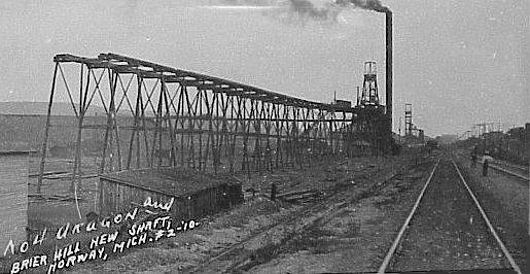
Photo Info: The Argon Mine complex in Norway,. MI, around 1910. [MINART]
Notes
Time Line
1895. July. The Aragon ships its Castile ore and stockpiles the lower grades, awaiting better prices. The Aragon has about 105,000 tons of ore in stock and is sending out only its first grade ore. The west drift is now under the city hall and the ore shows a width of 18 to 20 meet. [DD-1895-0713]
1911. The Aragon is another of the Oliver Iron Mining Company’s properties, and is located in the City of Norway, Michigan. This mine is operated by two shafts, Nos. 4 and 5. No. 4 shaft has a depth of 991 feet. It has three compartments, two for skips and one for pipes, ladderway, etc. The equipment at this shaft consists of one 20”x42” simple duplex first motion, hoisting engine, operating two drums each 6 feet in diameter with 9 foot face. One Corliss cross-compound steam, single-acting, four stage air compressor, steam 12”x 22”x30”, air 20”x12”x7¼”x4¼”x30”, providing air for pneumatic haulage plant in use at this mine. One simple steam, three stage tandem air compressor, steam 14”x16”, air 10½”x7¾”x3⅝”x16”, first installed for furnishing air for pneumatic haulage, now used as relay only. One 17½ K. W. direct current, 125 volt, belt driven generator for lighting purpose on surface. The boiler plant at No. 4 consists of three 264 H.P. Babcock & Wilcox water tube boilers.
No. 5 shaft has a depth of 1,052 feet and has four compartments, two compartments for skips of five-ton capacity each, one for cage and one for pipes, ladderway, etc. On the 11th level at this shaft are located two 18”-28”-47”-12”x24” triple expansion pumps. The equipment on surface here consists of one 28”x60” simple duplex, first motion Corliss hoisting engine, connected to two 12 foot drums—each 9 foot face and used for operating two five-ton skips. One 24”x42” simple Corliss hoisting engine, geared to one 12 foot drum, diameter of face 5½ feet and used for operating cage. There are also located at No. 5 shaft two compressors, one tandem compound, two stage, steam 18”x36”, air 20”x32”x36”. One straight line simple two stage air compressor, steam 20”x26”, air 22”x14”x26”. The boiler plant consists of two 264 H. P. and one 400 H. P. water tube boilers. Since the last meeting of the institute, a new machine, blacksmith and carpenter shop has been built in close proximity to No. 5 shaft. A new laboratory, a change house with capacity for 350 men, saw mill, oil house and captain’s office have also been erected. Old buildings of same nature as those mentioned, were formerly located near what was known as No. 2 shaft. This shaft has been abandoned on account of the ground caving, which also made necessary the construction on a permanent site for the buildings above noted. [LSMI-1911]
Contact Us

Email: webmaster@michiganrailroads.com